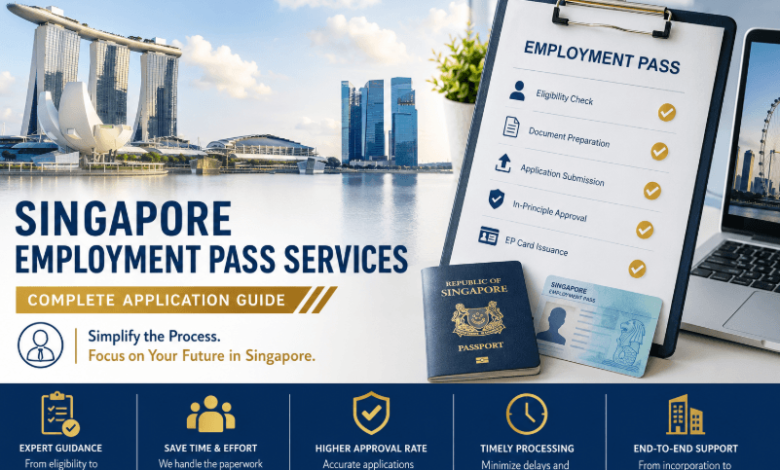
If you are a foreign professional planning to work in Singapore, or a business owner looking to bring in overseas talent, the Employment Pass is likely your first major hurdle. It is not complicated once you understand the system, but it does require careful preparation. A single missing document or incorrect declaration can set your timeline back by weeks.
This guide walks through everything you need to know about the EP application process in Singapore, including why many companies now rely on professional Singapore employment pass services to handle the paperwork and follow-ups.
What Is the Singapore Employment Pass?
The Employment Pass is a work visa issued by the Ministry of Manpower (MOM) that allows foreign professionals, managers, and executives to work in Singapore. It is typically issued for one to two years for first-time applicants and can be renewed for longer periods.
To qualify, applicants generally need a job offer from a Singapore-registered company, relevant educational qualifications, and a salary that meets MOM’s current threshold. As of 2026, the minimum qualifying salary for most sectors is SGD 5,600 per month, with higher thresholds for the financial services sector at SGD 6,200 per month. These figures are reviewed periodically, so it is worth checking MOM’s official portal before submitting.
Beyond the salary, MOM also evaluates whether the hiring company made genuine efforts to consider local candidates first. This is assessed under the Fair Consideration Framework (FCF), and employers who do not meet these expectations can face scrutiny during the application review.
Who Needs an Employment Pass?
Not every foreigner working in Singapore needs an EP. There are several pass types under MOM’s framework, and the right one depends on the applicant’s role, qualifications, and salary level.
The Employment Pass is generally suited for:
- Professionals with recognised degree qualifications
- Managers and executives in mid-to-senior roles
- Entrepreneurs who are also drawing a salary from their own Singapore company
- Foreign business owners relocating to manage operations here
If the role is more hands-on or trade-based, an S Pass or Work Permit may be more appropriate. An experienced corporate services provider can help assess which pass category fits your situation before any application is submitted.
The EP Application Process: Step by Step
Getting the Employment Pass approved involves several stages. Here is how the process typically unfolds.
1. Confirm Eligibility
Before anything is filed, the employer and applicant should run a check using MOM’s Self-Assessment Tool (SAT). This gives a preliminary indication of whether the application is likely to succeed based on salary, qualifications, and job type.
2. Prepare Supporting Documents
The employer applies on behalf of the candidate through MOM’s EP Online portal. Documents typically required include the candidate’s educational certificates, a recent resume, a copy of the employment contract, and details of the job scope. For roles in regulated industries, additional certifications may be needed.
3. Submit the Application
Applications are submitted online via EP Online. Processing typically takes three to eight weeks, though complex cases or those flagged for additional review can take longer. MOM may request further documents during this period.
4. Receive In-Principle Approval (IPA)
Once approved, MOM issues an In-Principle Approval letter. The candidate then enters Singapore on the strength of this IPA and completes the pass issuance process, which includes registering fingerprints and a photo at the Employment Pass Services Centre.
5. Collect the EP Card
After completing the in-person formalities, the physical EP card is issued. The entire process from initial submission to card collection can take anywhere from four to twelve weeks depending on the case.
Common Reasons EP Applications Get Rejected
Rejection is more common than many applicants expect. Understanding where applications tend to fall short can save you from unnecessary delays.
One of the most frequent issues is a salary that is technically above the minimum threshold but not competitive enough relative to the candidate’s age and experience. MOM uses benchmarks that factor in industry norms, and an offer that looks acceptable on paper might still fall short of what the system expects for a senior professional.
Another area that trips up companies is the Fair Consideration Framework requirement. Employers with at least 25 employees are expected to advertise the role on MyCareersFuture for at least 28 days before submitting an EP application. If this step was skipped or not properly documented, it can affect the outcome.
Incomplete or inconsistent documentation is also a recurring problem. Academic certificates that cannot be verified, job descriptions that are too vague, or salary details that do not match the employment contract all create unnecessary complications.
How Professional EP Services Make a Difference
Handling an EP application in-house is possible, but for many SMEs and startups, it adds a significant administrative burden on top of everything else a growing business needs to manage. This is where engaging Singapore employment pass services from a qualified corporate services firm makes practical sense.
A firm that handles EP applications regularly knows what MOM looks for. They review the application before submission, flag any red flags early, and manage correspondence if MOM raises queries. For foreign entrepreneurs setting up a new company in Singapore, this matters even more because the EP must often be processed alongside the company incorporation, which adds another layer of coordination.
Singapore employment pass services from an established provider like SH Koh and Partners typically include eligibility assessment, document preparation, submission through EP Online, follow-up with MOM on the employer’s behalf, and guidance through the IPA to card issuance stage. Some firms also assist with EP renewals, which involve their own requirements and timelines.
Given that errors in an EP application can lead to rejections that affect both the candidate and the company’s hiring timeline, the cost of professional assistance is often a reasonable trade-off.
EP Renewal: What Employers Often Overlook
First-time EP holders are typically issued a one or two year pass. Renewal should be applied for at least six weeks before the pass expires. MOM reviews renewal applications with updated salary and job information, so a candidate whose role or compensation has not progressed may face a tougher renewal than expected.
Employers should also note that EP renewal is not automatic. Each renewal is treated as a fresh assessment, and if salary benchmarks have moved or the applicant’s circumstances have changed, MOM will factor that in.
Keeping track of expiry dates and preparing renewal documents well in advance is something that corporate services firms often help with as part of ongoing client relationships.
Why Singapore Remains Attractive for Foreign Talent
Despite the more structured approach to foreign hiring in recent years, Singapore continues to draw professionals from across the region and beyond. The city’s stable regulatory environment, transparent tax system, and status as a regional business hub make it a practical base for companies and individuals alike.
IRAS continues to offer competitive personal income tax rates, and Singapore’s double taxation agreements with over 90 countries reduce the burden for internationally mobile professionals. For business owners, the ability to incorporate a Pte Ltd company through ACRA and then apply for an EP as a working director remains a viable route for foreign entrepreneurs.
Firms like SH Koh and Partners, which has been supporting businesses in Singapore since 1984, provide the kind of practical, integrated support that SMEs and startups often need: accounting, payroll, corporate secretarial, incorporation, and employment pass services all under one roof. That continuity means the same team handling your company setup can also manage your work pass applications, which reduces the back-and-forth that comes with using multiple providers.
If you are planning a move to Singapore or looking to bring a key hire on board, reaching out to an experienced corporate services firm early in the process is usually the more efficient path.
See also: How to Build a Successful and Sustainable Dental Business
Frequently Asked Questions
What is the current minimum salary for a Singapore Employment Pass in 2026?
The minimum qualifying salary is SGD 5,600 per month for most sectors and SGD 6,200 per month for financial services roles. MOM may adjust these benchmarks periodically, so it is advisable to verify on their official site before applying.
Can I apply for an EP if I own the company in Singapore?
Yes. Foreign entrepreneurs who have incorporated a Singapore company through ACRA can apply for an Employment Pass as a working director, provided the company can demonstrate legitimate business activity and the applicant meets the salary and qualification criteria.
How long does an EP application typically take?
Most straightforward cases are processed within three to eight weeks. Complex applications or those requiring additional documentation may take longer. Errors or missing information can extend this timeline significantly.
What happens if my EP application is rejected?
MOM will provide a reason for the rejection. Depending on the grounds, the employer can appeal or reapply with stronger supporting documentation. Working with a professional service provider can help identify what went wrong and how to address it before resubmitting.
Do I need to advertise the job locally before applying for an EP?
If the employer has 25 or more employees, they are required to advertise the position on MyCareersFuture for at least 28 days before submitting an EP application, in line with the Fair Consideration Framework. Smaller companies are exempt from this requirement.